
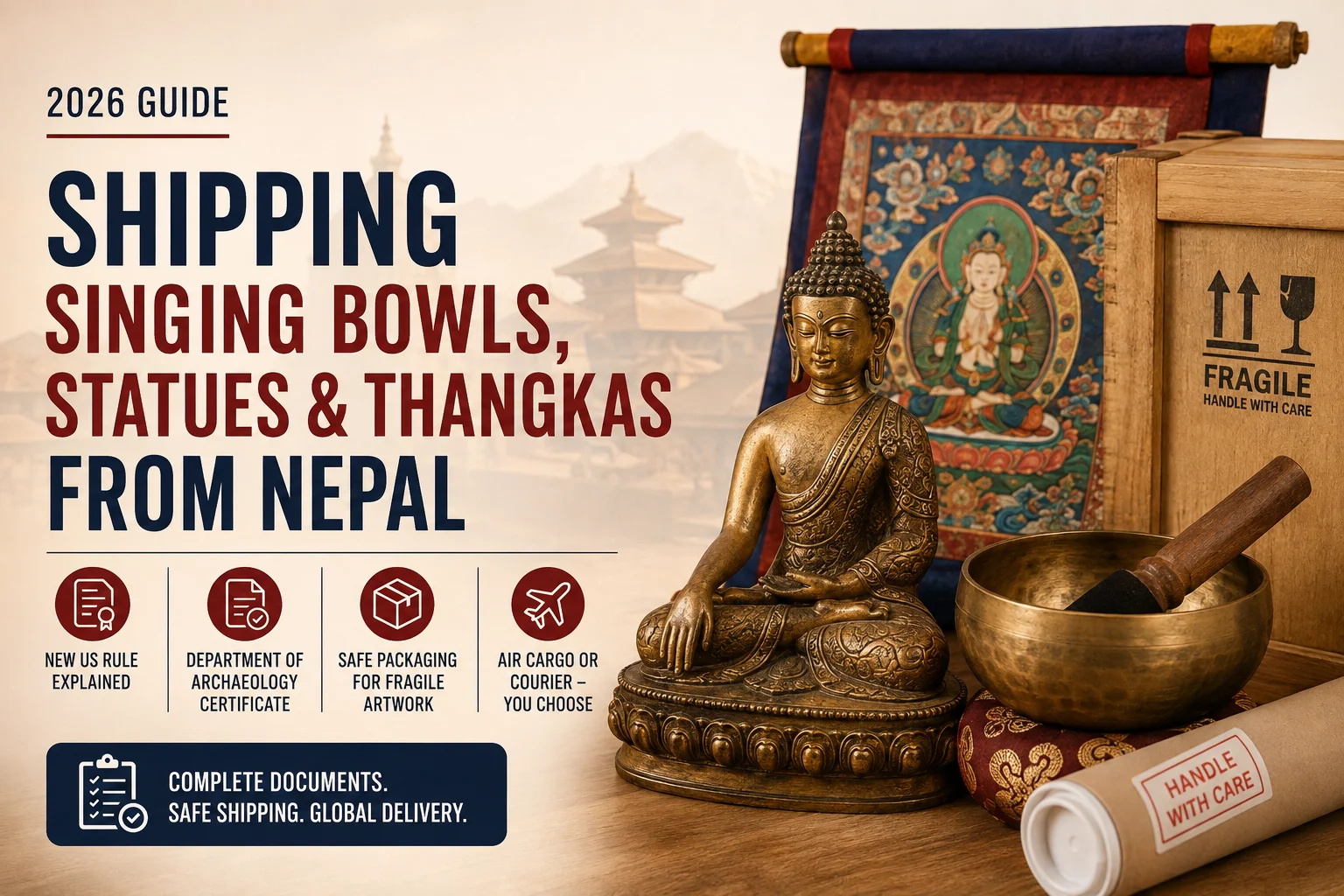

On August 12, 2026, the United States began enforcing new import restrictions on old Nepali cultural material. If you make, sell, or buy singing bowls, statues, thangkas, or paubhas that move between Nepal and the US, this rule affects your paperwork starting now. This guide explains what changed, what stays the same, and exactly what you need to export these pieces from Nepal without delays. On August 12, 2026, US Customs and Border Protection published a final rule restricting the import of certain archaeological and ethnological material from Nepal. It follows a bilateral agreement the two governments signed on January 8, 2026, under the Convention on Cultural Property Implementation Act. The restriction runs through January 8, 2031, and can be extended. The rule covers two categories: Archaeological material dated from around 32,000 BCE to 1770 CE. Think stone carvings, ancient metalwork, coins, and manuscripts from that span. Ethnological material dated from the 13th century CE to 1950 CE. This is the category that matters most for handicraft exporters. It names religious statues, thangkas, paubhas, ritual vessels, and singing bowls specifically. Here is the part that matters for daily business: the restriction applies to old pieces, not new ones. A singing bowl, statue, or thangka made after 1950, which describes the overwhelming majority of what leaves Kathmandu, Patan, and Bhaktapur workshops today, sits outside this rule entirely. What changed is the burden of proof for anything that looks old. US customs can now hold a shipment of genuinely antique or pre-1950 religious items unless the importer shows it left Nepal legally or was already outside Nepal before the restriction took effect. In practice, this makes one document more important than ever: proof from Nepal's own Department of Archaeology that a piece is a modern handicraft, not a restricted antique. Nepal has controlled the export of old religious and archaeological objects since the Ancient Monument Preservation Act of 1956. Under this law, anything more than 100 years old cannot leave the country without special clearance, and in most cases it cannot leave at all. For legitimate handicraft exporters, the relevant document is the Curio Clearance Certificate (also called a Check Pass Certificate), issued by the Department of Archaeology in Kathmandu. It confirms an item is a modern craft, not an object of archaeological or historical importance. For newly made singing bowls, statues, and thangkas, this clearance is routine. For pieces that look aged, hand-distressed, or antique-style, expect closer inspection, because customs officers on both ends are trained to look for exactly this. If you are a wholesaler shipping regular batches of new stock, build this certificate into your standard process rather than treating it as an occasional extra step. With the US rule now in force, buyers abroad will increasingly ask for it before they pay. A complete export file for singing bowls, statues, or thangkas from Nepal typically includes: EXIM Code – the exporter identity code issued by the Department of Customs and processed through the Nepal National Single Window (NNSW), linked to the ASYCUDA customs system. Without an active EXIM code, your declaration will not clear the system. Commercial Invoice – itemized value, quantity, and description of goods. Packing List – weight and dimensions per package, used to calculate volumetric weight. Customs Export Declaration – filed electronically through ASYCUDA/NNSW. Certificate of Origin – confirms the goods were made in Nepal. Many destination customs authorities ask for this regardless of any tariff program status. Department of Archaeology Curio Clearance Certificate – required for statues, thangkas, paubhas, and other religious or ceremonial items. Nepal's customs system runs on a risk-based channel model (green, yellow, and red). Clean, complete documentation is what keeps a shipment in the green channel instead of getting pulled for manual inspection. Singing bowls, statues, and thangkas fail differently in transit, so our team packs each type differently. You do not need to pack anything yourself. Just hand over the piece as is, and this is what happens before it goes on a pallet. Wrapped in multiple layers of bubble wrap, with every edge and protrusion cushioned separately. Bronze, brass, or copper statues go into a custom-built wooden crate, with foam or straw padding inside so the piece cannot shift. Sets of bowls are packed with padding between each one, to prevent metal-on-metal contact during transit. Rolled rather than folded to protect gold-leaf paintwork and prevent creasing. Rolled pieces go into a rigid waterproof tube; framed or mounted pieces go into a flat crate with acid-free tissue. Silica gel packs are added inside the packaging, since humidity, not impact, is the main risk for painted textiles and paper. Packaging is sized to keep volumetric weight down. Air freight charges are based on whichever is higher, actual weight or volumetric weight, so we avoid oversized crates on light items. Every fragile piece is packed as if the label will be ignored somewhere along the route, not just marked and hoped for the best. moves airport to airport and is the right choice for wholesale volume, bulk pallets, or heavier statues where cost per kilogram matters more than speed. The consignee or their customs broker handles clearance and pickup at the destination airport. is a door-to-door service better suited to a single item, a sample piece, or a time-sensitive gift shipment where the buyer wants tracking straight to their address. It costs more per kilogram but skips the destination pickup step entirely. If you are unsure which one your shipment needs, describe the size, weight, and urgency and ask for a recommendation before booking. The two services are priced and handled differently, so mixing them up in your planning slows things down rather than saving money. Pickup – Goods are collected from your shop, workshop, or factory in Kathmandu, Patan, or Bhaktapur. Department of Archaeology check – Statues, thangkas, and paubhas go through Curio Clearance before packing, so nothing is packed that later fails inspection. Custom packaging – Crating, wrapping, weighing, and volumetric calculation. Customs filing – Documents are submitted through ASYCUDA/NNSW and the shipment is declared at Tribhuvan International Airport's cargo complex. Dispatch – The shipment is handed over to the airline for the international leg. Tracking – You receive shipment tracking so you can follow the cargo until it reaches the destination airport. Individual tourists carrying personal souvenirs generally do not need an EXIM code, but they still need a Department of Archaeology certificate for statues, thangkas, or anything that could be mistaken for an antique. Artisans and businesses shipping commercially need the EXIM code regardless of shipment size. Any statue, thangka, paubha, or ritual object leaving Nepal should go through this check. Age is what customs officers look at first, so even a brand-new piece made in an aged or antique style should carry the clearance certificate to avoid questions at either end. Genuinely antique pieces (pre-1950 for ethnological items, pre-1770 for archaeological items) now require documentation proving legal export from Nepal or proof the item was already outside Nepal before August 12, 2026. New, contemporary handicrafts are not affected by this rule at all. Most holds trace back to missing or mismatched paperwork, most often the invoice value, HS code, or origin certificate not matching the declared shipment. Complete, consistent documentation before dispatch is what prevents this. Yes. Statues are usually billed on actual weight, while thangkas and other bulky-but-light items are often billed on volumetric weight instead. Since costs vary by weight, packaging, and destination, the most accurate way to get a number is to send your item details for a quote. The New US Rule, Explained Simply
The Department of Archaeology Certificate
Documents You Need Before You Ship
How We Pack Fragile Handicrafts for Air Cargo
Metal statues and singing bowls
Thangkas and paubhas
General approach for all three
Cargo or Courier: Which One Fits Your Shipment
Air cargo
Express courier
How the Export Process Works, Step by Step
Frequently Asked Questions
Do I need an EXIM code if I'm a tourist or small artisan shipping one item?
How do I know if my statue needs Department of Archaeology clearance?
Does the new US rule mean I can no longer sell old or antique-style pieces to US buyers?
What happens if my shipment is held at destination customs?
Is shipping cost different for a heavy statue versus a light thangka?
Send packages worldwide with trusted courier services in Nepal offering quick delivery, safe handlin...
Namaste Cargo Nepal makes international shipping simple, fast, and affordable. Send documents, parce...

Looking for a reliable Nepal courier service? Discover why Namaste Cargo Nepal is the top choice for...