
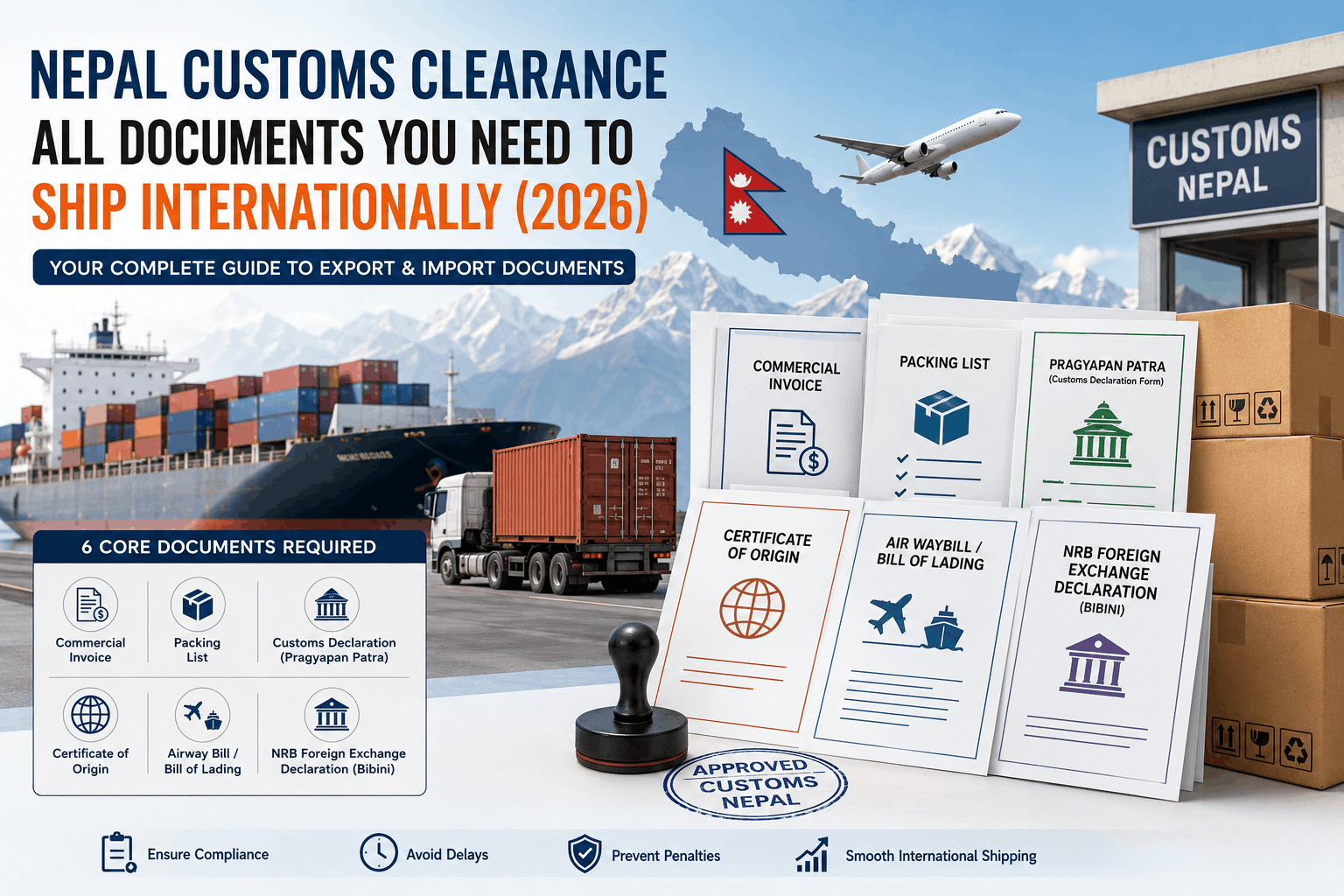
To get your shipments through Nepal customs and export them internationally, you must ensure that all necessary documentation is in place. Any missing document could result in delays that last for days or even weeks at the border or airport. To ship internationally from Nepal, there are six basic documents that you will need: Commercial Invoice, Packing List, Nepal Customs Declaration Form (Pragyapan Patra), Certificate of Origin, Bill of Lading/Airway Bill, and Nepal Rastra Bank Foreign Exchange Declaration (Bibini). Depending on your destination country and cargo, you may also require a GSP Form A, phytosanitary certificate, or HAN valuation certificate. This article will detail each document in simple terms, explaining its purpose, issuer, and relevance. Regardless of whether you ship products overseas once in a while or on a regular basis, bookmark this page for future reference. Have problems with preparing documentation? Namaste Cargo Nepal prepares documents and clears shipments for you. Contact us for a free consultation. Customs clearance refers to the process of obtaining clearance for the shipment of your goods from one international destination to another. In Nepal, this clearance is handled by the Department of Customs. Any form of cargo, regardless of whether it is air, sea, or road cargo, requires clearing and declaring at customs before leaving Nepal. Failure to declare your goods and provide proper documentation could result in the delay of your shipment, increased charges, and, in some cases, confiscation of your cargo. Nepal is a landlocked country, which makes the whole process a little different compared to other countries that have direct sea access. The sea freight that leaves Nepal has to first be transferred through land to India before being shipped out through the ports of India. This means that your shipment will pass through two sets of customs, Nepal and India. At Namaste Cargo Nepal, we offer complete custom clearance that take care of this entire process on your behalf. It is the main document for your shipment. It states to the customs department, as well as the buyer, exactly what you are shipping, its cost, and the terms of delivery. The invoice should contain the name and address of the exporter and importer, a description of the cargo, the HS Code, quantity, unit price, total value, and Incoterms (FOB or CIF). Note: The invoices should be made in English or Nepali language. In case of shipments exceeding NPR 500,000, it should be authenticated by the chartered accountant. Do not underestimate your invoice. Undervaluation of the invoice is the primary cause for shipments to be held up at customs. The packing list accompanies the invoice, but unlike the invoice, which deals with financial issues, it describes the shipment in terms of physical facts such as number of packages, contents, weight, and dimensions. The packing list facilitates the work of customs officials when examining your cargo. Failure to match your packing list with your shipment will result in delays. The Pragyapan Patra is Nepal’s official customs declaration form. This document has to be filed electronically via the ASYCUDA World system, Nepal’s official customs system, at the time of exportation. This document mentions details about your goods including its nature, value, and destination. This will help the customs to determine if you have to pay any tax or duty for exporting your goods. In most cases, there is no export duty in Nepal. Common error: The main reason for delays in Nepalese customs is the wrong HS code on the Pragyapan Patra. Make sure that you verify your HS code using the Nepal Customs Tariff 2081-82 before you file. The Certificate of Origin is a document that will prove to your buyer that your products have been manufactured in Nepal. This is important since a lot of countries offer Nepal special (reduced) duty rates for being an LDC. Your buyer’s customs may subject your shipment to regular duty rates without this document. This document can be obtained from either TEPC or the chamber of commerce of your location. The fee for processing this document is approximately 0.09% of the total value of your invoice. It normally takes 2 to 3 working days to get. In addition to the COO, a valuation certificate from HAN is required if you export handicrafts. This document is provided by the transport company and acts as a contract between the transporter and the exporter. It is proof that your goods have been accepted by the transporter along with its terms of delivery. Bill of Lading (B/L): Used for sea and road transport through Indian ports Air Waybill (AWB): Used for air transport from Tribhuvan International Airport (TIA), Kathmandu Without this document, you will not be able to receive your consignment at the destination. The original bill of lading, in particular, is a title of ownership for your goods. The Bibini is a foreign exchange declaration form issued by the Nepal Rastra Bank (NRB) for all export transactions in foreign currencies. The Bibini guarantees that the remittance you receive from selling your goods overseas will be in convertible foreign currency and will be brought back into Nepal within 90 days. It should be accompanied by either an L/C or an Advance Payment Certificate issued by your bank. This is usually the most forgotten document by new exporters. Lack of Bibini approval is the main reason why export shipments to Nepal are detained at Kolkata port. The six basic documents mentioned above are applicable for any type of cargo shipment. However, based on the mode of transport, a couple of extra documents will be required. Air cargo is the fastest mode of transportation from Nepal, and air cargo services are provided at Tribhuvan International Airport. If all your documentation is in place, the process will take 1 to 2 days. If you are shipping lithium batteries, chemicals, or any other dangerous goods through air, a Dangerous Goods Declaration has to be included. In case of valuables such as jewelry or electronics, an Insurance Certificate should be considered. Namaste Cargo Nepal's air cargo export service includes document preparation and priority customs filing for air shipments. As Nepal has no access to any seaports, the sea transport will first be transported to the Indian ports by road from Nepal. For this type of transport, two extra documents are needed: In-Bond Bill: It is necessary if the cargo goes through Indian territory. This document is essentially a bond document that ensures that the cargo will not be unloaded in India and will continue to the seaport. SAFTA Transit Documents: Most goods being imported from or exported to India are free of customs duties under the provisions of the South Asian Free Trade Area Agreement. For land and sea cargo shipments, Namaste Cargo Nepal's land and sea cargo export service manages the full multimodal documentation chain from Kathmandu to your destination port. The basic documents remain the same irrespective of the destination. However, some destinations may need additional documentation, especially those that grant preferential tariffs for Nepalese goods. Generalized System of Preferences (GSP) is an arrangement in which developed nations grant Nepal’s exports concessional or free import duties. For this purpose, the goods you export must be endorsed with a certificate that confirms their origin from Nepal. In the past, such a certificate was provided in the form of GSP Form A, a paper certificate endorsed by Nepal Customs. But in the case of European Union countries, the conditions have changed. For export to EU countries from Nepal, you need to register yourself in the Registered Exporter (REX) database of the European Union. Then instead of issuing the GSP Form A, you issue the Statement on Origin certificate, which you include in the invoice or packing list. This certificate can be issued in any commercial documents and is valid in all 27 countries of the European Union, including Norway, Switzerland, and Turkey. In case of exporting goods to Europe, you should register yourself under REX through Trade and Export Promotion Centre (TEPC). This step is often ignored by cargo companies in Nepal, and hence the importer ends up paying duties on imported goods into EU countries. Certain products require other forms of permissions and certification besides the standard documents. The following are some of the requirements for the commonest export categories in Nepal. HAN Valuation Certificate issued by Handicraft Association of Nepal – mandatory for all handicraft exports CITES Permit – mandatory if the product includes materials from endangered species (e.g. specific animal skin, feathers, etc.) Certificate of Origin issued by TEPC Namaste Cargo Nepal's team can help you prepare handicraft export documentation as part of our export service. Phytosanitary Certificate issued by the Department of Plant Resources that verifies the absence of any pests and diseases. Necessary for all plant-based produce to be exported to the EU, USA, Australia, and Japan Lab test certificate regarding food safety issues which mandatory in Europe for many importers For tea from Nepal: pesticide residue test reports are more and more frequently requested by EU importers GAN Recommendation letter issued by Garment Association of Nepal that is required for shipments under EU quota Proof of legal importation of fabric (raw material) to Nepal prior to production MSDS (Material Safety Data Sheet): required by air carriers and most customs authorities Import permit from the destination country's regulatory body (varies by country) Here’s the full process in chronological order, including each step that you must complete. Step 1: Register for an EXIM Code To export any goods from Nepal, you require an EXIM (Export-Import) Code from the Department of Customs. The registration is a one-time exercise. You’ll also need a PAN/VAT registration done. The initial registration process takes about 7-14 days. Step 2: Prepare Your Commercial Invoice and Packing List After receiving the order confirmation from your customer, prepare your commercial invoice and packing list. Ensure that all details on both documents match in terms of value, quantity, HS code, and Incoterms. A mismatch between the invoice and the packing list is the second most frequent cause of customs delays. Step 3: Obtain Your Certificate of Origin Approach TEPC or your local chamber of commerce along with a copy of your invoice. In case you are sending the goods to the EU, you should be applying for your REX registration at the same time. The process takes 2-3 working days. Step 4: Get GSP Form A (if needed) In case the destination country demands that you get your GSP form A (as in Australia, Canada, Japan, UK), apply for your GSP form A while applying for your COO. In case you are exporting your handicraft products, then apply to HAN for a valuation certificate too. Step 5: File the Pragyapan Patra via ASYCUDA Filing of Pragyapan Patra can be done electronically by submitting the Customs Declaration Form using ASYCUDA World in case of air cargo through TIA and land via the nearest border custom office. Step 6: Complete the NRB Bibini Declaration Make a submission of the Foreign Exchange Declaration Form at Nepal Rastra Bank along with the Letter of Credit (L/C) or Advance Payment Certificate of your bank. This needs to be fulfilled before the shipment departs from Nepal. Step 7: Hand Over to Your Freight Forwarder After completing all the documents, submit them to the freight forwarder. They will coordinate with the shipping company for the issuance of the Bill of Lading or Airway Bill. How much time is required in each step? Registration of EXIM Code: 7-14 days (only once) Certificate of Origin from TEPC: 2-3 days Filing of Pragyapan Patra: 1 day Approval from NRB Bibini: 3-5 days Total pre-shipment process: about 5-10 days for exporters who have the EXIM Code. Namaste Cargo Nepal handles Steps 3 through 7 as part of our standard custom clearance service. You focus on your business; we handle the paperwork. When importing your goods into Nepal from another country, here are the documents that you will require for clearing customs in Nepal. VAT: 13% on almost all imports, based on CIF value plus customs duties Customs Duty: 0%–80% based on product category (highest customs duties apply to vehicles) Processing Time: 1–3 days for standard imports with full documentation; 5–7 days if inspection is needed; 4 weeks for products requiring special permits or laboratory testing For importing goods into Nepal, Namaste Cargo Nepal's air cargo import service and land and sea cargo import service cover documentation, duty payment, and customs liaison at all major entry points including TIA, Birgunj, Biratnagar, and Bhairahawa. Even experienced exporters get tripped up by these. Avoid them. Mistake 1: Wrong HS Code on the Pragyapan Patra If you have used an incorrect HS code, then customs will manually classify your products, leading to a delay of 3-7 days in your import process. Make sure that you cross-check your HS code with the Nepal Customs Tariff 2081-82 before applying. Mistake 2: Invoice Value Does Not Match the Certificate of Origin The commercial invoice and the value mentioned in your COO should match; otherwise, the authorities will physically inspect your products and revise their value. In case of deliberate under-declaration of your products' value, you may get blacklisted from the ASYCUDA system. Mistake 3: Missing the NRB Bibini Approval This is the most costly mistake. Your goods can get stuck at the Kolkata port for 10 days or more if you fail to get bibini approval. The demurrage charges can easily go into the tens of thousands of rupees. Mistake 4: Expired or Inactive EXIM Code The EXIM Codes should always be up-to-date. In case your EXIM Code expires because of any modification in the registration of your company or PAN/VAT registration, your goods will get delayed at the customs checkpoint. It is advisable to always check your EXIM Code status prior to each new export season. Mistake 5: Shipping to the EU Without REX Registration A majority of Nepalese exporters continue to provide GSP Form A when exporting goods to the EU, without realizing that the EU has now adopted the REX system. In such cases, your buyer will have to pay the full duty on the product since you won’t have valid REX registration. ▭ EXIM Code (confirmed active) ▭ Commercial Invoice (certified by CA if above NPR 500,000) ▭ Packing List ▭ Pragyapan Patra — filed via ASYCUDA ▭ Certificate of Origin — from TEPC or Chamber of Commerce ▭ NRB Bibini Declaration — with L/C or Advance Payment Certificate ▭ Airway Bill (AWB) — issued by airline ▭ Dangerous Goods Declaration (if applicable) ▭ Bill of Lading (B/L) — issued by shipping line ▭ In-Bond Bill — for India transit ▭ SAFTA Transit Documents ▭ Shipping Line Manifest ▭ GSP Form A: for Australia, Canada, Japan, UK ▭ REX Registration + Statement on Origin: for EU, Norway, Switzerland, Turkey ▭ SAFTA COO: for India and SAARC countries ▭ HAN Valuation Certificate: for all handicraft exports ▭ Phytosanitary Certificate: for tea, herbs, agricultural products ▭ GAN Recommendation Letter: for garment/textile exports to EU ▭ CITES Permit: for items containing protected species materials ▭ Commercial Invoice ▭ Packing List ▭ Bill of Lading or Airway Bill ▭ Pragyapan Patra (import version) ▭ BBN 4 Form (Nepal Rastra Bank) ▭ Import License (if restricted goods) ▭ Insurance Certificate ▭ Delivery Order from TMC (for Birgunj / Biratnagar / Bhairahawa ICDs) ▭ Special certificates (phytosanitary, lab report, etc.) if applicable Six main documents are required: Commercial Invoice, Packing List, Pragyapan Patra, Certificate of Origin, Airway Bill/Bill of Lading, and NRB Bibini Declaration. As the USA does not have GSP for Nepal at the moment, you won’t need to provide the GSP Form A. But you’ll still require your COO to declare the origin of the goods. Along with the six main documents, you’ll also need to register yourself in the EU REX system and attach a Statement of Origin to your commercial invoice/packing list. The old GSP Form A can no longer be used as a preferential origin document in the EU for Nepal. You should apply for your REX number through TEPC before sending your first EU shipment. Pragyapan Patra (प्रज्ञापन पत्र) is the official customs declaration form in Nepal. This is the form that you use when you declare the export goods including type of goods, value, quantity, destination, and HS Code at Nepal Customs. From 2006 onwards, it has to be submitted online using the ASYCUDA World system. Pragyapan Patra is also known as Single Administrative Document (SAD) or Yellow Form. Yes. Any registered business in Nepal that wishes to export or import commercial goods will require an EXIM Code provided by the Department of Customs. It is a one-time registration process; however, it has to be kept up to date. Individual shipments may not require an EXIM Code but all commercial shipments will require an EXIM Code. Without this, your shipment cannot be registered in ASYCUDA. GSP Form A is a document that proves your goods are produced in Nepal and thus qualify for lower rates of duty according to the Generalized System of Preferences. It is required when exporting to Australia, Canada, Japan, or the UK. For exports to the EU, Norway, Switzerland, and Turkey, Nepal has adopted the REX system and uses a Statement on Origin in place of the GSP Form A. This document is issued by TEPC at a cost of NPR 15 per set of four copies. Standard handicrafts such as handmade paper, pottery, or handwoven items only require the usual six documents, along with the COO and HAN valuation certificate. If, however, your handicraft incorporates any material derived from protected species, including specific types of feathers, animal hides, ivory, and plant-based products, you will also need a CITES permit. Special Thangka handicrafts may be subject to restrictions as per the Archaeological and Religious Objects Protection Act. Bibini is the Foreign Exchange Declaration that is to be done in Nepal Rastra Bank. This Bibini indicates that the foreign money from the export will be brought back into Nepal within 90 days. This Bibini needs to be submitted along with the Letter of Credit or Advance Payment Certificate from your bank. Without this Bibini approval, your shipment will not be able to receive payment in Nepal and can be seized at customs till this is approved. In case of any minor mistake like misspellings or discrepancies in value, you will be asked to amend and resend. In case of any major mistake like an incorrect HS Code or missing mandatory document, the shipment will be detained for further inspection. This will add 3-14 days to the delivery process and cause inspection fees, demurrage fees, and sometimes even fines. Getting all this paperwork right on your own is possible, but it takes time, attention to detail, and up-to-date knowledge of Nepal's customs regulations, which change regularly. Namaste Cargo Nepal's customs clearance team handles: EXIM Code registration support Commercial invoice and packing list preparation Certificate of Origin application (TEPC and Chamber of Commerce) GSP Form A and REX Statement preparation Pragyapan Patra filing via ASYCUDA NRB Bibini form submission End-to-end customs liaison at TIA Our experience in Nepal’s cargo industry for many years ensures that we keep ourselves abreast of any modifications made to customs regulations and international trade agreements. To learn more about how we handle documentation as part of our full shipping service, read our detailed guide on documentation needed for shipping from Nepal, or explore our commercial and non-commercial customs clearance advice. Ready to ship? Get in touch with Namaste Cargo Nepal; we will walk you through exactly what you need for your specific shipment.What Is Customs Clearance and Why Does It Matter?
The 6 Core Documents (Required for All International Shipments)
1. Commercial Invoice
2. Packing List
3. Customs Declaration Form – Pragyapan Patra
4. Certificate of Origin (COO)
5. Bill of Lading (Sea/Road) or Airway Bill (Air)
6. Nepal Rastra Bank Foreign Exchange Declaration (Bibini)
Documents by Shipment Mode: Air vs Sea/Road
Air Freight from Kathmandu (TIA)
Sea/Road Freight via Indian Ports
Documents by Destination: What Changes Based on Where You Ship
The GSP Form A and the New REX System for EU
Special Documents for Specific Products
Handicrafts (Carpets, Pashmina, Thangkas, Woodcarvings)
Agricultural Products, Tea, and Herbs
Garments and Textiles
Chemicals and Pharmaceuticals
Step-by-Step: How the Nepal Export Customs Process Works
Importing Into Nepal — What Documents Do You Need?
Nepal's import taxes at a glance:
5 Mistakes That Cause Customs Delays in Nepal
Quick Reference Checklist: Print or Save This
Export Checklist (Shipping FROM Nepal)
All shipments:
Air freight only:
Sea / road freight only:
Destination-specific:
Product-specific:
Import Checklist (Shipping TO Nepal)
Frequently Asked Questions
What documents do I need to ship from Nepal to the USA?
What documents do I need to ship from Nepal to the EU?
What is Pragyapan Patra?
Do I need an EXIM Code to ship from Nepal?
What is GSP Form A and when do I need it?
Can I ship handicrafts from Nepal without special permits?
What is the Bibini approval from Nepal Rastra Bank?
What happens if my documents are wrong at Nepal customs?
How Namaste Cargo Nepal Can Help
Send packages worldwide with trusted courier services in Nepal offering quick delivery, safe handlin...
Namaste Cargo Nepal makes international shipping simple, fast, and affordable. Send documents, parce...

Looking for a reliable Nepal courier service? Discover why Namaste Cargo Nepal is the top choice for...