
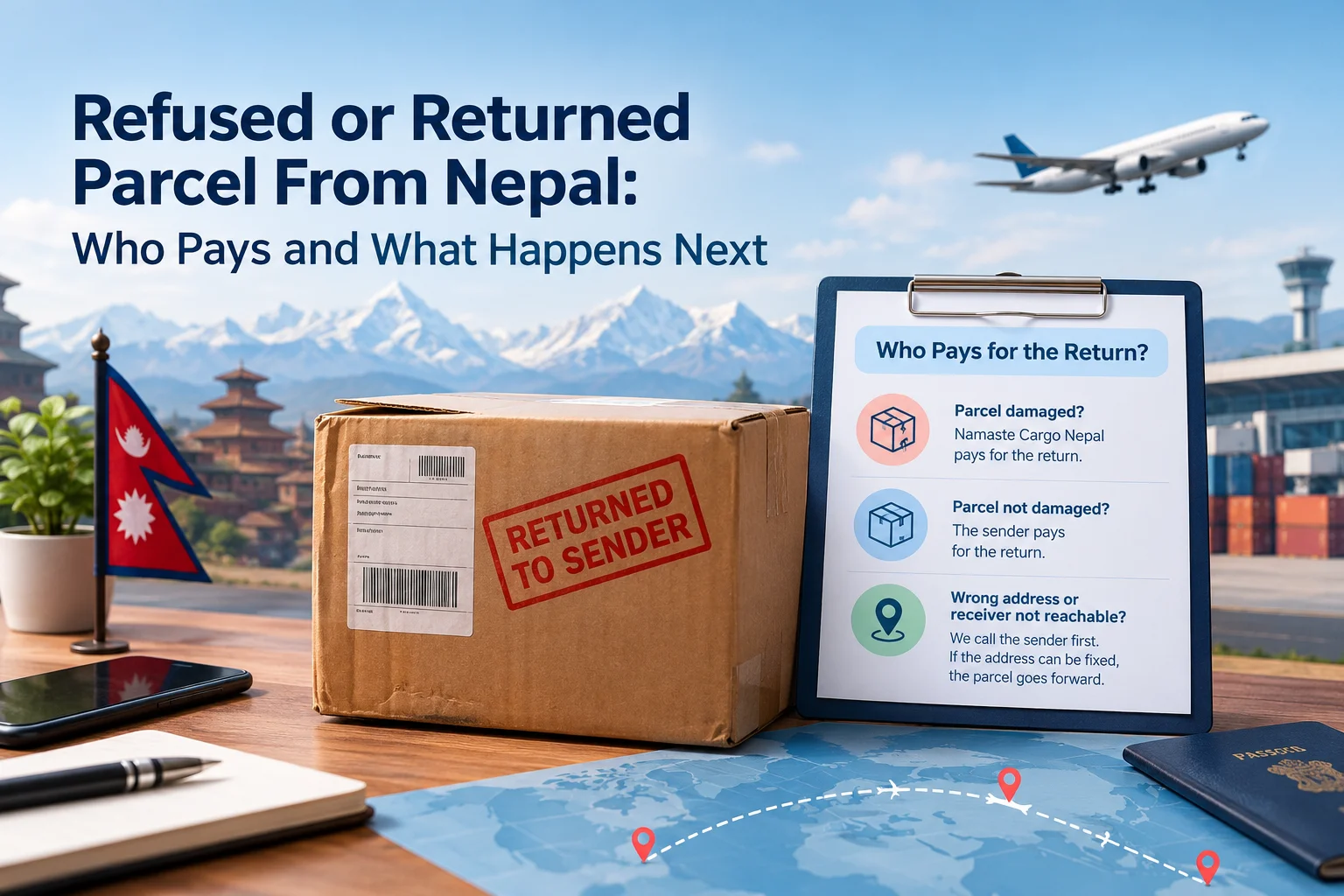

A parcel you sent from Nepal comes back with the status “returned to sender." The receiver never opened it or never got it. Now you have one question: who pays for this? The answer depends on one thing. Was the parcel damaged? Parcel damaged: Namaste Cargo Nepal pays for the return. Parcel not damaged: the sender pays for the return. Wrong address or receiver not reachable: we call the sender first. If the address can be fixed, the parcel goes forward and no return is needed. This guide is about courier shipments, which are door to door. Cargo works differently. See the short note near the end, or read the difference between courier and cargo. Most returns come from six causes. Only some of them are final. The rule is simple. Why this rule? Damage happens while the parcel is in the shipping chain, so we carry that cost. A refusal for any other reason is a decision outside our control, so the cost stays with the sender who booked the shipment. Tip for receivers: if a parcel looks damaged, take a photo of the box before you refuse it, and send the photo to the sender. This makes the reason clear from the start. The delivery fails at the destination. Tracking changes. You may see words like “delivery refused”, “receiver not available” or “return to sender”. Check the status on our tracking page. We find the reason. We keep contact records for both the sender and the receiver, so we can reach the right person fast. The sender decides. Fix the problem and send it forward, or bring the parcel back. If you choose a return, the parcel travels back to Kathmandu. This is a full journey in reverse, and it starts only after the delivery is closed at the destination. The parcel meets Nepal customs again. Returned goods do not skip customs. More on this below. Duty and tax are charged by the destination country, not by the courier. If the receiver will not pay, the parcel can be held, returned or destroyed, depending on the country. That is why this reason is growing. Small parcels lost their duty-free treatment in two big markets: Data checked October 2026. Duty rules for small parcels are changing fast, so check the destination rule before each shipment. The EU rule is aimed at online sales. Personal gifts and commercial shipments can be handled differently, so tell us your parcel type before you ship. Tell the receiver before you ship that duty or tax may apply. Declare the real value and the exact item description. Do not write “gift” on commercial goods. Customs checks declared values. Read more about the Nepal side in our guide on cargo held at customs in Nepal. A returned parcel is not simply handed back at your door. It comes back into Nepal as a re-import, so it meets customs again. Goods made in Nepal that are exported and then brought back are generally treated as re-imports. Duty can apply. Customs law gives relief in some cases, such as returned undelivered parcels and rejected goods. Under the VAT Act, goods made in Nepal that return because the receiver refused them can be released against a VAT security. The goods must leave Nepal again within three months, and the security is returned after re-export. Customs matches the returned goods against your original export records. The invoice, packing list and export declaration must agree with what is inside the box. Keep the box closed and the labels on. A parcel that looks changed raises questions at the counter. The VAT security rule is for goods made in Nepal. For other goods, ask us. Customs rules change, so confirm the current rule before you plan around it, and message us before the parcel lands in Nepal so the paperwork is ready. Act fast. In some countries an unclaimed parcel can be held for only a short time and then destroyed. Silence from the sender is the worst option. For low-value goods, compare the return cost with the value of the goods before you decide. A customer wrote an address in a different city than the one they meant. The courier could not find the receiver. We called the sender, because we keep the contact details of both sides. The sender gave the right address, the parcel was rerouted, and it reached the receiver 2 days later than planned. No return. No extra trip back to Nepal. The only thing that saved this parcel was a working phone number on the label. Write the full address: city, area, street, postal code and landmark. Add a phone number the receiver actually answers. Tell the receiver a parcel is coming, and share the tracking number. Ask the receiver to confirm they will accept it. This matters for surprise gifts. Ask us if duty or tax may apply at the destination. Declare the real value and exact items. Your packing list must match what is in the box. See documents needed for shipping from Nepal. Check the destination’s banned items before you pack. See the prohibited items guide. Pack for the full journey so damage is never the reason. Selling to customers abroad? The same checks apply to every order. See shipping orders from Nepal to customers abroad. Cargo is airport to airport. There is no door delivery, so there is no door to refuse. The risk is different: if the receiver does not clear and collect the shipment at the destination airport, it waits there and storage charges can build up. Agree who will clear the shipment before it leaves Nepal. Yes. The courier then marks the delivery as refused and the parcel is returned, unless the sender and the receiver sort out the problem first. The sender pays the return if the parcel is not damaged. If the parcel is damaged, Namaste Cargo Nepal pays. The reason is checked, the sender is contacted, and the sender chooses to fix and resend or to return. A returned parcel then goes through Nepal customs again. There is no fixed time. It depends on the country, the courier at the destination and how fast the sender decides. For a guide, our outbound times are 3 to 7 days for express and 10 to 15 days for economy, depending on the country. A return is another full trip. Yes, once it is back in Nepal and cleared. Fix the reason for the return first, or it will come back again. The parcel can be held, returned or destroyed, depending on the country. If it is not damaged, the return cost is the sender’s. Tell the receiver about possible duty before you ship. Message us on WhatsApp with your tracking number as early as possible. The sooner we know, the more options you have.Quick answer
Why a courier parcel from Nepal gets refused or returned
Who pays for a returned parcel?
What happens step by step after a refusal
Receiver refused to pay duty abroad: what now?
To avoid a refusal over duty:
What happens when a returned parcel reaches Nepal
Resend, reroute or return? How to choose
A real case from our desk
How to stop a parcel from coming back
What about cargo shipments?
Frequently Asked Questions
Can a receiver refuse a parcel?
Who pays if a parcel is refused?
What happens to a refused international parcel?
How long does a returned parcel take to come back?
Can I resend a returned parcel?
What if the receiver refuses to pay customs duty?
Can I stop a parcel after I ship it?
Send packages worldwide with trusted courier services in Nepal offering quick delivery, safe handlin...

Namaste Cargo Nepal makes international shipping simple, fast, and affordable. Send documents, parce...

Looking for a reliable Nepal courier service? Discover why Namaste Cargo Nepal is the top choice for...